Most of us spend the rest of our lives attached to the pop music of our late childhood and teenage years – when we had no perspective and everything was excitingly new. Some of us, by accident of when we were born, have been luckier than others in this regard. I was fortunate to become musically aware just as the Beatles released their third single, From me to you. I am still moved by its romance. I also became a Cliff Richard fan – probably after seeing Summer Holiday – and then became rather fond of Herman’s Hermits . . .
I can see now that I was following the lead of my older brother. He had no one to guide him and was therefore having to pioneer his own way through the innovations and excitements of 1960s pop music. My friend Paul, meanwhile, had older brothers, and their friends, who not only played records but also played guitars and sang – and rather more sophisticated stuff than I was used to : Leonard Cohen, Phil Ochs, Donovan and The Incredible String Band.
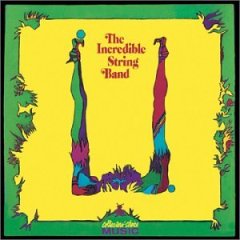
Paul first played me the String Band’s double album ‘U’, a studio recording of a show they had performed in both the UK and in the US – which had been a disaster. The album was indeed dreadful – out of tune and rough at both its edges and in between. Did he play me other String Band albums as well ? I don’t recall. All I know is that at some point – like Hirem Pawnitof the Highwayman – I gained enlightenment[1] and realised that ‘U’ was a work of genius. I must have then gone on to listen to all the other String Band albums available. I was utterly diverted.
The result was that nearly everything else was rendered ordinary. Nothing was either lyrically or musically as engaging as the songs of Robin Williamson and Mike Heron. The good news is that this saved me from the horrors of Heavy Metal and 1970s Top of the Pops. Fortunately it did not prevent my appreciation of Joni Mitchell, Leonard Cohen, CSN(& Y), and so on. Nonetheless, it always took some effort to switch from immersion in the String Band to listening to other artists. In fact, it still does.
It remains a mystery where the String Band’s peculiar originality came from. It’s well known that after recording their first album – The Incredible String Band (1966) – with Clive Palmer as a member of the band, Robin Williamson went to Morocco. He came back with a collection of obscure musical instruments and a singing style much influenced by the Arabic. But the fact is he was already a unique guitar player, songwriter and singer even before his Moroccan venture – October Song, for example.
Mike Heron, meanwhile, had apparently come from a rock and rhythm and blues background – which sounds to me like something electronically amplified and accompanied by a drumkit. This is not at all what he created with the String Band – Maybe Someday, for example, and then everything he wrote for their second album, Layers of the Onion (1967), and much beyond. Both his songs and his vocal style were as previously unheard of as those of Robin Williamson, though very different. But their differences combined into a vocal, instrumental and lyrical never-been-heard-before originality.
The conclusion has to be that both Robin and Mike were unique and original creative talents.
They were also widely appreciated – by Paul Mc Cartney, for example, and by Robert Plant, Rowan Williamson (Archbishop of Canterbury) and Billy Connolly – especially Bill Connolly, who heard them early on and never recovered from it.
What does not seem to have been so appreciated is the String Band’s eighth album (depending on how you count), ‘U’, released in 1970. By then, some already felt the String Band’s best days were over. However, I find it contains songs and music as good as those that came before, and some works of characteristic genius.
I think there was a misunderstanding.
‘U’ – ‘a surreal parable in song and dance’[2] – was first a show, not just a concert. The dance – including dramatic performance – was provided by Stone Monkey. It ran for ten days at the Camden Roundhouse, North London, in April 1970. While the audiences seem to have thoroughly enjoyed the experience, the response of the critics was mixed at best. Still, someone thought it was success enough for the band to take it to the Filmore East in New York, at the ISB’s own expense. However, perhaps because of the UK critics, it was not a success there. The band were forced to complete the six shows without Stone Monkey to save money. Hoping to recoup some of the financial losses, Joe Boyd, the ISB’s producer, quickly took them into a studio in San Francisco to record the show’s songs. The two hours of the ‘U’ album was then recorded in just forty-eight hours.
No doubt the show was rough around the edges, but that was part of the String Band’s ethos – to entertain, delight, tell tales and make their audience laugh. No doubt the recording was rushed, but then it captures the character of a live show. In other words, the album is the nearest thing you could get to the live show without being an actual live recording – which is probably all for the best given the visual – and rough – nature of the live performances.
So here’s the misunderstanding. It was not a studio album, it was a live show whose songs and music were being captured quickly while it was still fresh.
It also reached thirty-four in the official UK album charts, which was a quite respectable achievement.
According to Robin, who conceived the show, it was called ‘U’ because its story is U shaped. It starts with somebody in a golden age who then descends through successive lifetimes of decreasing awareness until he finally ‘gets back to a good state of mind again’. Whether that was clear in the actual shows – which included more than was recorded – or in the ‘dancing’ – I cannot say. However, I can say that you’d never know that was the story from listening to the album. Perhaps others of Robin’s explications describe it better. It was, he says, ‘off the cuff’, ‘Pretty light-hearted’, ‘the story itself is of the loosest possible’.’[3]
Nonetheless, the music and the songs are irresistible. I separate the two because some of the tracks are extended musical compositions – El Wool Suite, Partial Belated Overture, Bridge Theme – while in the songs there are both lyrics and arrangements among the ISB’s most memorable – Queen of Love, Time, Invocation – as well as classic ISB humorous entertainment – Hirem Pawnitof and Robot Blues. And then there’s the wonderful Juggler’s Song which combines both.
I have had the delight of seeing the String Band live – and deliberately entertaining – a number of times, and I never minded the rough edges. If you come to ‘U’ with the understanding of what it was and how it came about I like to think that you too might agree that it’s among the String Band’s best.
*