The Gargoyles on the Tower

The following article, from the January 1895 Curdridge Parochial Magazine, was recently published in the Curdridge Parish News. It was discovered in the archives of the Hampshire Records Office (HRO 98M82/PZ34) by my friend and fellow parishioner Henrietta Taylor. Thanks to the Hampshire Records Office for permission to post it here:

We have been kindly favoured with the following interesting notes on the figures sculptured on the Church Tower:-

“THE GARGOYLES ON THE TOWER”

There are eight of these placed just below the chequered work of the battlements. They represent two legends and are from the drawings of T. G. Jackson, Esq., A.R.A. (the architect of the Church and Tower), and have been executed by Messrs. Farmer and Brindley.

On the south side is Sir Bevis (clad in chain armour and in the act of drawing his sword); at the south-west corner is Sir Bevis’ favourite horse “Arundel;” on the west side is “Josyan,” Lady Bevis (Sir Bevis’ wife); at the north-west corner is the “Blood-thirsty Boar”; on the north side “Sultan Ermyn” (father-in-law of Sir Bevis); on the north-east corner the “Giant Ascupart” (Sir Bevis’ trusted servant); on the east side “The Twins” (sons of Sir Bevis); and on the sout-east angle of the Turret “The Witch Kitnox,” or “Kitnocks,” as it is now spelt.

The story of the witch is an old Curdridge fable, well known to most of our readers; suffice it to say, that in days gone by, when evil befell either the parish or its inhabitants it was always attributed to the power exerted by the witch.

The remaining seven gargoyles depict the history of Sir Bevis who, as the son of the Earl of Southampton, was conveyed, whilst still a youth, over the seas to the Holy Land to the court of the Sultan Ermyn, who tried in vain to make Sir Bevis renounce the Christian religion. He became a valiant and brave soldier. Alone, and on foot he sought out, from the recesses of a deep forest, the man-eating boar which he slew after a severe contest, and for this courageous deed the Lady Josyan, the Sultan’s daughter, presented him with the splendid Arab horse Arundel. He eventually wooed, and married the Lady Josyan by whom he had twin sons. Whilst on a hunting expedition he left Lady Bevis for a short time alone in a hunt. By the treachery of his servant, the Giant Ascupart, she was abducted, and Sir Bevis returned to mourn the loss of his wife, and to find his twin sons motherless. After making provision for his children he set off in pursuit of the giant who was eventually killed, and Lady Bevis was restored to her rightful lord.

Such is the brief outline of an old legend of the tenth century, and it is reported that Sir Bevis’ sword is still to be found amongst the many interesting relics at Arundel Castle.
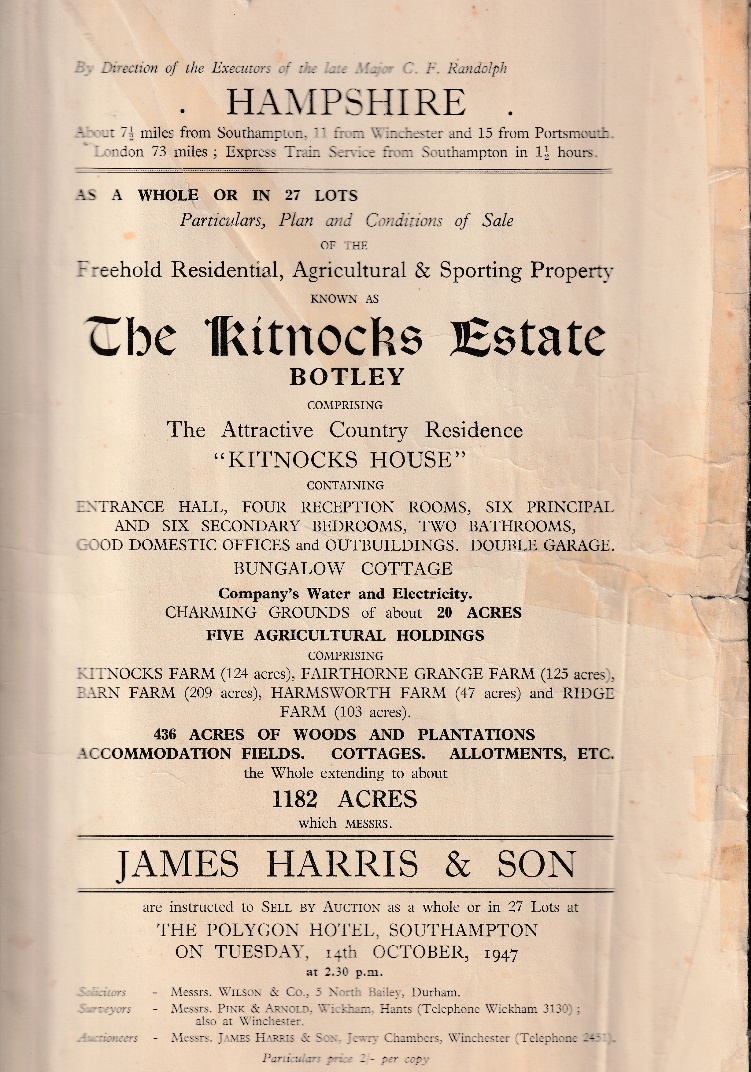
Kitnocks Estate Sale, 1947.

Kitnocks Estate Sale, 1947.

On October 14th, 1947, a Sale by Auction of ‘The Kitnocks Estate, Botley’ was held at the Polygon Hotel in Southampton. The former owner of the Estate, Major Charles F Randolph, had died earlier the same year and the property was now to be sold ‘as a whole or in 27 lots.’ The lots included numerous arable fields and enclosures, also ‘accommodation land’, ‘valuable’ and ‘attractive’ blocks of woodland and various cottages, old and ‘modern’. They also included five whole farms. The entire estate amounted to some 1,182 acres.

The centre of the estate was of course Kitnocks House at the top of Kitnocks Hill, set in ‘charming grounds of about 20 acres’. Among the farms was Kitnocks Farm, which is adjacent to the House, although in this case the auctioneers managed to correctly locate the Farm in Curdridge rather than in Botley. The other farms were : Fairthorne Grange Farm (on the Burridge road), Barn Farm and Ridge Farm in Curbridge (both now subsumed by the North Whiteley development) and Harmsworth Farm, also in Curbridge. The blocks of woodland included Bedlams, Hangmans and Suttons Copses – I.e. the daffodil and bluebell woods in Curbridge. In fact, there couldn’t have been much of Curbridge that wasn’t part of the Estate.

Most of the farms and cottages were already let to tenants, a number of whom are still familiar local family names – Barker, Oakley, Pink, Hillier, Churcher and Mears. In fact it was Brian Mears, my neighbour in Outlands Lane, who lent me the sale document for the Estate. The Mears family have lived in Curdridge since at least the 15th Century – their name appears on a list of tenants from that time. At the time of the Kitnocks Estate sale, Brian’s grandfather Alfred was the tenant of one of the ‘modern cottages’ in Outlands Lane – one of the timbered, mock-tudor dwellings that had originally been built as staff quarters by Augusta Burrell of Fairthorne Manor in the early 1900s. The written notes on the sale document reveal that the property was purchased by Alfred’s brothers David and John, whose home address it already was, when they weren’t way with the Navy. They were still living there when we first moved into Outlands Lane in 1993, and until they passed away.

Among the lots of land was a piece at the top of Kitnocks Hill – the plot still known as the Kitnocks Triangle, which now has houses on it. However, a ‘reservation’ in the sale document notes that Major Randolph had, in his Will, already gifted a small section of this land to Curdridge Parish Council to serve as a bus stop. This is where the bench on the crest of the hill sits now and where many will still remember catching the Hants & Dorset bus number 53 which ran between Fareham and Southampton – and vice-versa of course.

Kevan Bundell