Flying Officer Krishan Kumar Sahgal, RIAF (Service no. IND2345).
This article is based on an interview conducted by Kevan Bundell with Mr Kishan Kumar Sahgal, with additional information from his wife and family and from the internet.
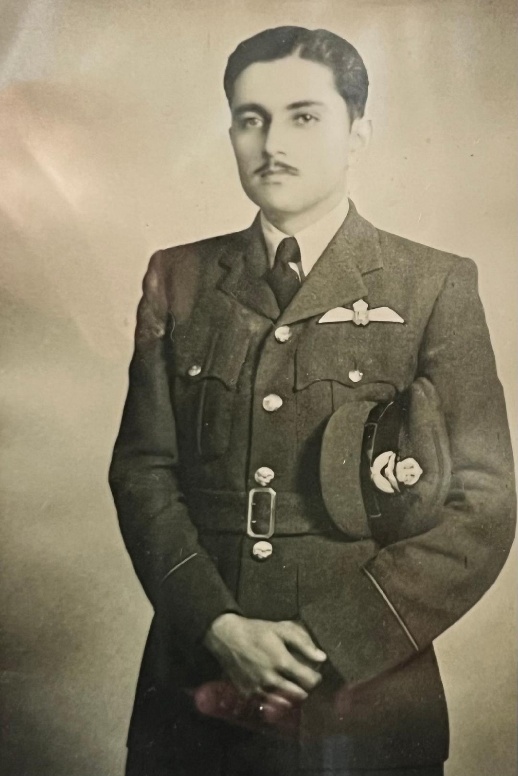
Kishan Kumar Sahgal was born on 24 December 1921 in Calcutta, at the home of his maternal Grandfather, Colonel Sir Ram Nath Chopra. He was brought up in Rawalpindi and then sent to the Doon School, Dehradun. He was not happy there and moved to St. Xavier’s High School in Calcutta, living with his Grandparents.
As Mr Sahgal recalled, he wanted to join the Airforce. (This was in 1943). However, his mother insisted he study medicine, which he therefore did, in Calcutta. However, one day, back in Rawalpindi, he went to see the District Collector, a Mr Cuthbert, in order to get a gun license. Mr Cuthbert asked him what he was doing with himself and suggested he might like to join the Airforce. Sahgal replied that he would indeed like to join the Airforce but his mother was opposed to the idea. The collector said he’d have a word with Sahgal’s father – whom he knew. Sahgal joined the Airforce soon after.
He was sent to Dehradun Academy for interviews and a medical, which he passed. He was sent to Walton, near Lucknow, for Ground Training and then to151 Operational Training Unit at the Elementary Flying Training School at Jodhpur as an Officer Cadet for 3 months flying instruction. He apparently did his first solo after just five hours of training.
Mr Sahgal says that he trained mostly on Hawker Hart biplanes and North American Harvards, but he must also have flown Hurricanes because, before he joined an active squadron, he suffered engine failure in a Hurricane and had to make a crash landing.
His story was this:
Flying a Hurricane, he ‘buzzed’ a village tank – a reservoir – where some women were taking their baths. Having done so twice, his engine failed. He rolled upside down to bail out, but in his confusion rolled back upright again. This was fortunate because he then realized he was flying at only 500 feet. He made a crash landing, all the while wondering what the local Pathans, renowned for their warrior spirit and sense of honour, might do to him. He need not have worried, the Pathans are also known for their generous hospitality. As per regulations, he had to stay with his aircraft, but the villagers brought food and drink and ate with him. Some hours later an Air Force lorry turned up. ‘Why didn’t you bring an ambulance?’ asked Sahgal. ‘We only came to collect the body’, was the reply. In fact, he had been injured in the crash. Having undone his harness to bail out he had then smashed his nose on landing. The nose was fixed with goat cartilage and flesh from his leg.
On another occasion, ‘as a young pilot’, Sahgal decided to ‘beat up’ a ‘friendly’ train. Two other pilots took the Hurricane he was flying up after him and when it was finally taken for refueling, a locomotive whistle was found stuck in the bottom of the fuselage. The British C.O. grilled all three pilots as to who was responsible and all three denied it. A few days later the C.O. offered Sahgal a whiskey in the Mess, and then another, and another – the third of which Sahgal declined. The C.O. asked him if he was in fact the guilty party. ‘This is the mess, not your office ?’ ‘Yes’ agreed the C.O. Sahgal confessed and no more was said about it.
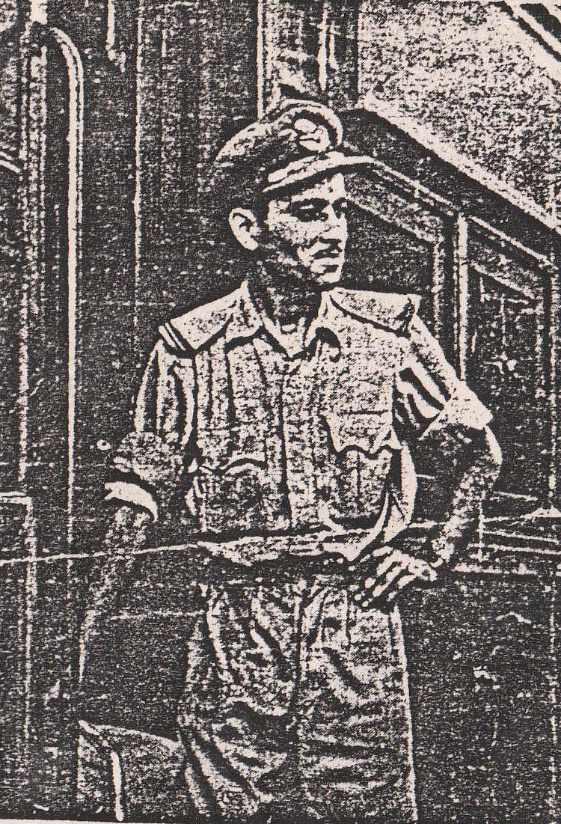
The crash took place on 1st January 1944[1]. On the 10th January, he joined No. 9 Squadron at either Bhopal (according to his family) or possibly at Jodhpur, where the squadron had been recently formed on the 3 January 1944. In any case, the Squadron was soon after, in April 1944, sent to Hathazari in Chittagong, on the Burma front[2]. There he flew operationally in Hawker Hurricane Mark IIc’s and later in Mark IX (?) Spitfires – by that time based in Arakan, according to Mr Sahgal. He also flew Westland Lysanders occasionally. His duties mostly involved escorting bombers in their sector.[3] On one occasion he escorted Mountbatton’s Dakota. When flying Hurricanes the instructions were not to tackle Japanese Zeros, which could ‘turn circles in your circles’. Sahgal’s family report that at Arakan he was given the role of acting C. O. and later of acting Squadron Leader.
Sahgal’s mother remained opposed to his being in the Airforce all through the war. She would ‘beat her breast hysterically’ whenever a telegram arrived. When the war ended, she insisted he quit. He did so, unwillingly, in the 1st March, 1944. Afterwards, he said, he remained ‘disappointed’ and ‘unforgiving’ of his mother.
*
Kevan Bundell 10.08.26
-
https://www.bharat-rakshak.com/indianairforce/database/2345
↑ -
https://military-history.fandom.com/wiki/No._9_Squadron_IAF
No. 9 Squadron, Indian Air Force (Wolfpack) was formed at Lahore on 3 January 1944 under the command of Squadron Leader A.W. Ridler of the Royal Air Force. In April 1944 they were moved to Hathazari in Chittagong to take part in the Burma Campaign. ↑
-
https://grokipedia.com/page/no_9_squadron_iaf
Initially equipped with Hawker Hurricane IIc fighters, the squadron focused on fighter-bomber roles, conducting close air support and ground attack missions against Japanese forces starting in April 1944.[1] These aircraft were armed with 20 mm cannons and capable of carrying bombs or rockets for tactical integration with ground forces. ↑